Recent Work · No. 1
Breakfast With Van Gogh and a Wombat
My kids are eight and ten, and on school mornings they eat breakfast in the kitchen with a TV on the wall. That screen was dead air — and a kid's morning, it turns out, is prime real estate for curiosity. The question that started this project: what if, while they ate their cereal, the TV showed them one thing worth knowing — big enough to read across the room, gone before anyone got bored?
What got built
The answer lives at tomhalpin.com/learn.html. It shows one fact at a time in very large type: a word of the day, a scientist and what they figured out, a math oddity, the thirty biggest countries each with a globe map, famous paintings, how to count to one hundred in Mandarin. Each card holds the screen for thirty seconds, then fades to the next, with a progress bar creeping along the bottom so the boys know when the change is coming.
There are 227 cards at the moment — including nearly a hundred words from a middle-school vocabulary list, reworded for the breakfast table. At thirty seconds each, the deck runs almost two hours before it repeats, which outlasts any breakfast we've ever had. Each morning the page reshuffles itself using the date as the random seed: fresh order every day, but steady within the day, so a mid-toast browser refresh doesn't jump the sequence. The whole thing is one HTML file — no framework, no database — and the facts are a single plain list inside it, on purpose. My ten-year-old already writes a little Python and JavaScript; editing a list of facts is exactly his speed.
The free museum
The part I didn't expect: Wikimedia Commons turned out to be an art museum, an atlas, and a language lab, all free. Each artist card cycles through two or three paintings — thirty-five in all, from Starry Night to Hokusai's wave to Klimt's golden Adele — swapping every six seconds. Each country card shows an orthographic globe with the country in green and its neighbors around it. The Mandarin numbers zero through ten play real native-speaker recordings, twice each, with the browser's built-in Chinese voice covering the compound numbers past ten. None of it needed an API key or a dollar. It did need every file verified before shipping, and some careful curation, because art history is enthusiastically full of nudes. Chagall made the deck as words only — his paintings are under copyright until 2055.
The feature I killed
The best lesson came from a feature that didn't survive. Version one pulled real "on this day" history from Wikipedia each morning. The first day I tested it, three of the five events were deadly disasters — a balloon accident, a capsized boat, a plane crash. So I wrote a keyword filter, and it worked: the grim stuff vanished. Then a card slipped through about the repeal of Section 28, a British law concerning homosexuality — nonviolent, historically significant, and not remotely the conversation I'd planned to moderate over cereal at seven in the morning.
A keyword filter can strip out disasters, but it can't tell you what belongs at a breakfast table. Only a parent can.
So the live feed is off, permanently. Every card on that screen is now one a parent has read first. Filtering is cheap; vetting is what you can actually trust.
What stuck
The other lessons were small and physical. Text that looks bold on a laptop goes thin from across a kitchen — the whole deck got a weight bump after I squinted at the Tanzania card from the far counter. Browsers refuse to play sound until someone touches a key, so the first Mandarin number of the day waits politely for a keypress. And a TV browser is a genuinely hostile venue: hide the cursor, forbid scrolling, and assume the remote is the only keyboard anyone will ever use.
Mostly, though, I learned that a deck like this is a conversation, not a monologue. It kept growing the same way it started — one "could you add..." at a time: more artists, then three paintings per artist instead of one, then Mandarin numbers, then a deliberately funny definition of soporific. Somewhere in there a wombat showed up, because any self-respecting fact deck needs the animal with cube-shaped poop.
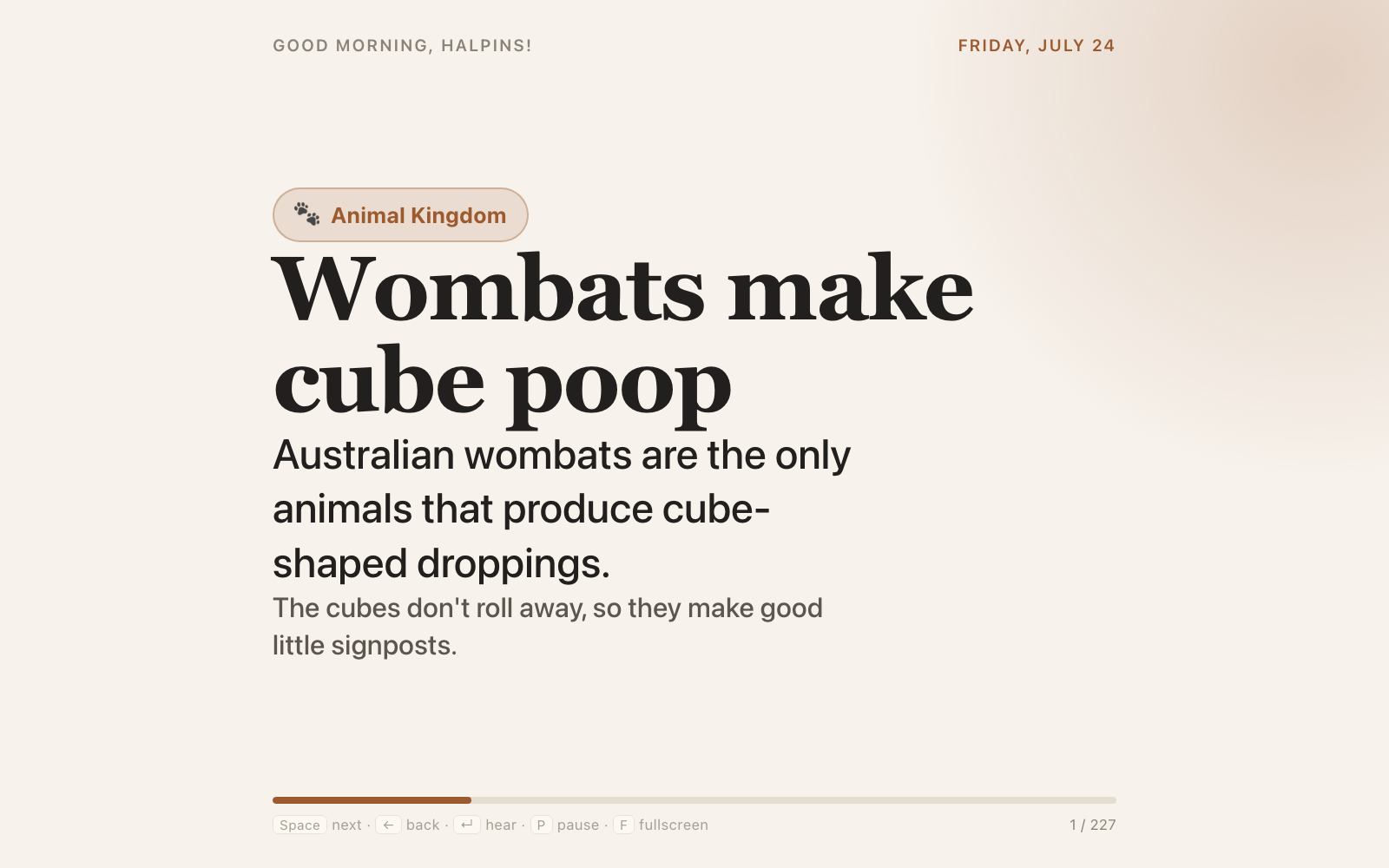
The page is live at tomhalpin.com/learn.html — best experienced fullscreen on a kitchen TV, with cereal.